Prioritize this visit if you appreciate grand civic architecture and the history of the Dutch Golden Age. The scale of the marble-clad Citizen’s Hall and the intricate sculptures of Atlas provide a sense of 17th-century Dutch ambition that smaller canal houses cannot replicate.
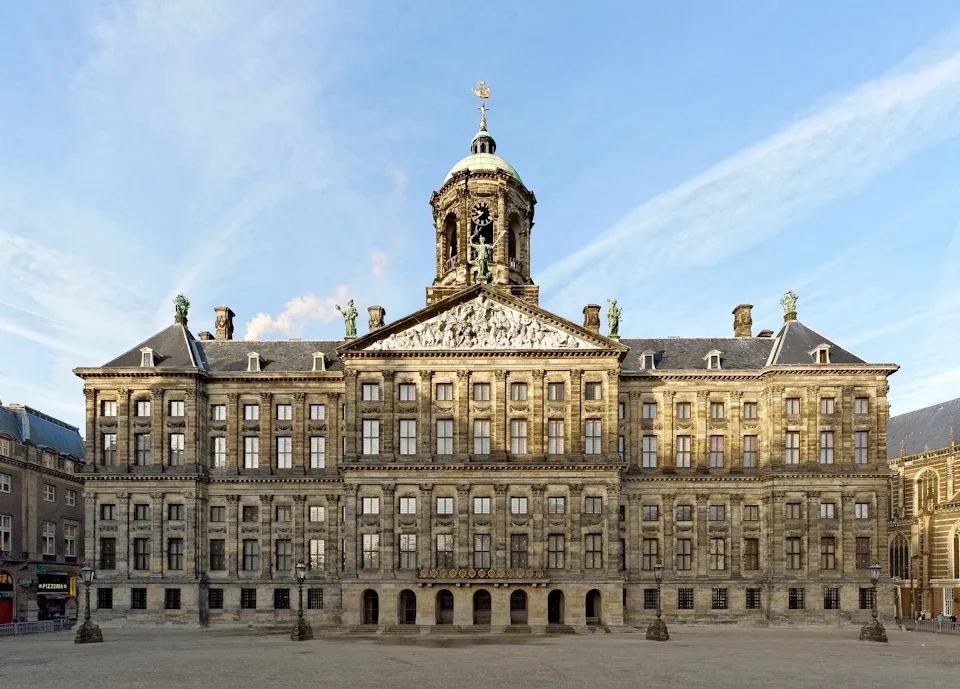
Royal Palace of Amsterdam
Why visit
You may skip it if you are looking for a warm, lived-in royal residence, as the palace functions more as a formal monument and can feel somewhat cold and austere. If your schedule is tight and you prefer the intimate atmosphere of the Jordaan or the art-heavy Rijksmuseum, this site may feel like a secondary priority.
What to know beforehand
The Royal Palace is a monument to civic power rather than a domestic royal residence. The Citizen’s Hall is the highlight, featuring marble floors that map the world to reflect Amsterdam’s historical dominance.
It is a must-visit for those interested in Dutch Golden Age history, though visitors looking for intimate royal living quarters may find the vast, echoing marble halls somewhat impersonal.
The audio guide is essential for understanding the intricate allegories and sculptures throughout the rooms. As an active state building, the palace closes for official ceremonies; the entrance board on Dam Square provides the definitive daily opening hours for public access.
Pro Tip: Look for the hidden details in the Tribunal sculptures, which were designed to remind 17th-century judges of the weight of their decisions.
🎫 Tickets, tours & discounts
Royal Palace Amsterdam Entrance Ticket
- Access to the State Rooms
- Mobile ticket entry
- Free mobile audio guide
- View the Citizen's Hall
Small Group Guided Tour (Royal Palace Amsterdam)
- Professional English-speaking guide
- 1-hour interior tour
- Skip-the-ticket-line entry
- Historical insights on Dutch Golden Age
Royal Palace Amsterdam & 1-Hour Canal Cruise
- Entry to the Royal Palace
- 1-hour Amsterdam canal cruise
- GPS audio guide on boat
- Flexible cruise departure times
Private Tour: Royal Palace Amsterdam
- Private professional guide
- Customizable tour pace
- Deep dive into royal history
- Direct entry access
Which ticket to choose
Unlike many other major European landmarks, the Royal Palace of Amsterdam keeps things simple. There is only one standard admission ticket for adults, which costs €13.50 and includes a comprehensive audio guide. There are no tiered VIP access levels or fast-track upgrades sold directly by the palace. You simply book a specific date and time slot online.
The most common mistake first-time visitors make is assuming they can buy a ticket that includes access to private royal quarters. The royal family still uses the building for state events, so the visitable areas are strictly limited to the grand public rooms, such as the Citizens' Hall and the Throne Room.
- Standard Admission: Covers all open historical halls and includes the audio guide.
- Under 18 Ticket: Free admission, but a time-slot ticket must still be booked online.
- Museumcard / ICOM: Free entry, but you must reserve your time slot in advance and present your physical card at the entrance.
Best time to visit
The palace is open daily from 10:00 AM to 6:00 PM. Because it is located right on Dam Square, it draws heavy foot traffic. The calmest hours are immediately after opening at 10:00 AM or in the late afternoon after 4:00 PM. Visiting during these quieter windows makes it much easier to photograph the massive Citizens' Hall without a crowd in your frame.
For solo travelers and photographers, the late afternoon slots offer the best light filtering through the high windows. Families will find the morning slots more relaxed before the midday rush.
Combos and discounts
If you plan to use a tourist pass, be aware that the Royal Palace of Amsterdam is not included in the I amsterdam City Card or the Go City Amsterdam Pass. This is a surprise to many travelers who expect it to be covered.
The best way to save is by utilizing the Dutch Museumcard (Museumkaart), which grants free admission. Additionally, children and youth under the age of 18 enter completely free of charge, making this an affordable stop for families.
There are no official combo tickets bundled directly with other attractions like the Rijksmuseum or the Van Gogh Museum, so you will need to purchase those entry tickets separately.
When it makes sense to book a tour
For the vast majority of visitors, a guided tour is unnecessary. The standard admission ticket includes a high-quality audio guide available in multiple languages, including English. There is also a dedicated audio tour designed specifically for children.
The audio guide provides plenty of context about the building’s transition from a Golden Age city hall to a royal residence under Louis Napoleon.
A live guided tour is only worth considering if you are traveling in a pre-arranged group of more than 15 people, which requires booking through the palace administration. Otherwise, exploring at your own pace with the provided audio headset is the most efficient and enjoyable way to experience the palace.
Crowd indicator
Expect peak crowds during midday and weekends, with potential security delays at the entrance.
Mini-calculator based on crowd levels by day and time.
This day has average visitor density. This slot has a higher chance of a comfortable visit: compromise between light and visitor flow.
Nearest days
How to find the entrance
The Royal Palace stands prominently on Dam Square, but the imposing front doors are reserved for state ceremonies and remain closed to the public. To enter, walk to the side of the building that faces the Nieuwe Kerk (New Church) on the street named Mozes en Aäronstraat. This is where the dedicated visitor entrance is located.
Once inside, every guest must pass through a security checkpoint similar to airport screening. You should account for at least 15 minutes of transit time from the square to the galleries due to these checks.
The palace enforces a strict bag policy; any item larger than an A4-sized bag, as well as umbrellas and large coats, must be deposited in the free cloakroom or lockers before you can proceed to the Marble Hall.
- Security screening for all visitors and belongings
- Mandatory cloakroom for backpacks and large bags
- Brief queues at the audio guide distribution desk
Practical limits & what to bring
Royal Palace of Amsterdam
Amsterdam
Netherlands
EUR
Things to consider before your visit
The palace is an active official residence of the Dutch Monarch, which means security is a priority. Every visitor must pass through an airport-style scanner, which can create a brief wait even during your reserved time slot.
The interior features vast marble floors and grand halls; while there is no strict dress code, comfortable shoes are recommended for navigating the hard surfaces.
The building is fully accessible to visitors with reduced mobility. Elevators provide access to all public levels, and the palace offers wheelchairs for those who need them. Since the palace is used for state functions, it can close to the public on short notice, but your pre-booked ticket remains the best way to ensure entry on open days.
Prohibited and allowed items
To preserve the 17th-century interiors and delicate marble artworks, the following items are restricted:
- No liquids, food, or chewing gum.
- No large backpacks or bags (anything exceeding A4 size).
- No umbrellas.
- No tripods, selfie sticks, or professional lighting equipment.
- No flash photography.
- Small handbags and mobile phones for personal photos are allowed.
Storage and belongings
The palace provides a free cloakroom and self-service lockers located immediately after the security entrance. All bags larger than a standard sheet of paper, as well as backpacks and wet umbrellas, must be stored here.
Please note that the storage area is small and cannot accommodate large suitcases or bulky travel luggage; there are no facilities for oversized bags on-site.
Strollers are permitted inside the galleries, though you may be asked to park them in a designated area if the halls become exceptionally crowded to manage floor congestion.
Location and what's nearby
What the district is like
- The historical epicenter of Amsterdam, centered around Dam Square, where monumental 17th-century architecture meets the city's busiest pedestrian flows.
- A high-energy hub perfect for old-town culture, featuring a mix of royal heritage, grand department stores, and national monuments.
- The area serves as the primary meeting point for first-time visitors, street performers, and shoppers navigating the city's radial canal belt.
Nearby on foot (up to 15 minutes)
- Nieuwe Kerk — A 15th-century Gothic church hosting major art exhibitions and royal ceremonies · 1 min walk
- National Monument — The iconic white stone pillar honoring Dutch victims of World War II · 2 min walk
- De Bijenkorf — Amsterdam's premier luxury department store housed in a grand historic building · 3 min walk
- Magna Plaza — A stunning neo-Gothic former post office now serving as a shopping center · 3 min walk
- Amsterdam Museum — Interactive exhibits detailing the city's history within a former medieval orphanage · 6 min walk
- Begijnhof — A secluded 14th-century courtyard offering a silent escape from the city noise · 8 min walk
- Anne Frank House — The preserved canal house where the Frank family hid during the war · 10 min walk
15–30 minutes by transport
- Rijksmuseum — The national gallery housing masterpieces by Rembrandt and Vermeer in a grand palace · 15 min by tram
- Van Gogh Museum — The world's largest collection of works by the famous Dutch post-impressionist · 18 min by tram
- Albert Cuyp Market — A sprawling outdoor street market famous for stroopwafels and local atmosphere · 20 min by tram
- Vondelpark — The city's largest green space, ideal for a break from the urban center · 22 min by tram
Where to eat nearby
- The Duchess — Michelin-starred Mediterranean dining in a grand former bank hall · high-end · reservation required · 3 min walk
- Restaurant d'Vijff Vlieghen — Traditional Dutch cuisine in five historic 17th-century canal houses · above average · recommended to book · 8 min walk
- Café de Jaren — Local favorite with a canal-side terrace and light European fare · mid-range · no reservation needed · 10 min walk
- The Pancake Bakery — Classic Dutch pancakes in a 17th-century warehouse near the Prinsengracht · casual · no reservation needed · 12 min walk
Ready-made itinerary for the day
Start your morning at the Royal Palace to beat the largest crowds, then step next door to explore the exhibitions at Nieuwe Kerk. After a grand lunch at The Duchess, take a short walk to the hidden Begijnhof courtyard for a moment of quiet before heading toward the Anne Frank House for an afternoon visit.
End the day with sunset views along the nearby Prinsengracht canal or shopping at the luxury boutiques of De Bijenkorf.
ReferenceFacts
Read more
Numbers and Scale
- Foundation: 13,659 wooden piles support the entire structure, a massive engineering feat necessitated by Amsterdam's soft, marshy ground.
- Citizen's Hall: 34 meters long and 30 meters high, this central space was the largest of its kind in Europe when the building opened.
- Construction Period: 17 years were required to complete the exterior and main halls, with the building officially opening in 1655.
- Historical Cost: 8.5 million guilders were spent on the project, making it the most expensive secular building in the world during the 17th century.
- Architectural Status: The palace was often referred to as the Eighth Wonder of the World by contemporaries due to its scale and classicist design.
Myths and Misconceptions
- Myth: The building was originally constructed as a royal residence for the Dutch monarchy. Reality: It was built as Amsterdam’s Town Hall and only became a palace in 1808 under Louis Bonaparte.
- Myth: The King of the Netherlands lives in the palace full-time. Reality: King Willem-Alexander resides at Huis ten Bosch in The Hague and uses this palace only for state functions.
- Myth: The statues on the roof are made of solid gold. Reality: The figures, including Atlas and the personification of Peace, are made of bronze and were never intended to be gold.
Rare and Unusual
- The Vierschaar: This marble-carved chamber was a public tribunal where judges sat to pronounce death sentences in full view of the Dam Square.
- Napoleonic Legacy: The palace contains one of the world's most complete and best-preserved collections of Empire-style furniture, left behind by Louis Bonaparte.
- Celestial Floors: The marble floor of the Citizen's Hall features massive maps of the Eastern and Western hemispheres, showing the world as it was known in the 1700s.
- The Cog Vane: The weather vane atop the tower is shaped like a medieval merchant ship, a symbol of Amsterdam's early maritime power.
- Hidden Ventilation: The building utilizes a 17th-century natural air-circulation system with hidden shafts designed to keep the massive stone halls cool.
BackgroundHistory
Read more
The building’s identity changed forever in 1808 when Louis Bonaparte, brother of Napoleon, declared himself King of Holland and converted the civic hall into a royal residence. He introduced the lavish Empire-style furniture and decor that still fill the rooms today.
After the French occupation ended, the palace was returned to the Dutch monarchy, serving as a backdrop for historic events including the abdication of Queen Beatrix and the inauguration of King Willem-Alexander.
A Living State Residence
Today, the palace is not a dusty museum but a functioning official residence used by the King for state visits, New Year receptions, and award ceremonies. When official business is not in session, the palace is open to visitors who can explore the Citizen’s Hall.
This central space features a marble floor inlaid with maps of the eastern and western hemispheres, symbolizing the reach of the Dutch empire at the height of its power.
♿ Accessibility & families
Accessibility and Family Policy
The Royal Palace is fully accessible for wheelchair users and visitors with reduced mobility. A side entrance provides level access, and a large internal lift connects all floors, including the grand Citizen’s Hall and the upper galleries. Manual wheelchairs are available for loan at the information desk free of charge.
Families with children under 18 benefit from free admission, though a valid ticket is still required for entry. Visitors under the age of 16 must be accompanied by an adult. While the palace is spacious, the security screening at the entrance is mandatory for all guests and can lead to short outdoor queues during peak hours.
Practical Information
* Strollers: Permitted throughout the palace. You must use the elevator to move between levels. Large strollers may be requested to be left in the secure cloakroom during high-occupancy periods.
* Children's Audio Guide: A dedicated interactive audio tour is available for children aged 7 to 12, included in the ticket price. * Facilities: Accessible toilets are located on the ground floor.
Note that the palace floors are historic marble and can be slippery; children should be supervised to avoid running. * Cloakroom: Large bags, backpacks, and umbrellas must be stored in the free cloakroom before entering the state rooms.
🏢 On-site amenities
Restrooms and Accessibility
Clean, modern restrooms are located in the basement level and are free for all ticket holders. These facilities are accessible via both stairs and an elevator. Baby-changing stations are available in the same area.
Storage and Security
Large bags, backpacks, and umbrellas are not permitted inside the state rooms. Visitors must use the free lockers located near the entrance for any items larger than an A4 sheet of paper. There is no cloakroom for heavy luggage, so items must fit within the standard locker dimensions.
Gift Shop
A museum shop is situated near the exit. It offers a selection of books on Dutch history and the monarchy, as well as Delftware, postcards, and palace-themed gifts. It is a convenient stop for high-quality souvenirs that reflect the building's 17th-century heritage.
Food and Water
There is no cafe or restaurant inside the Royal Palace. To protect the historic marble floors and furnishings, food and drinks—including bottled water—are prohibited in the galleries.
There are no water fountains on-site, but the palace's location on Dam Square provides immediate access to dozens of dining options ranging from casual kiosks to formal brasseries.
Connectivity
Public Wi-Fi is not provided for visitors. However, a handheld audio guide is included with every entrance ticket, providing detailed commentary on the rooms and artworks without requiring a personal data connection.